Okay, with the title out of the way, this is my belated post that I mentioned I would write. The one where I go on and on about Dick, and mention Moorcock, but mostly talk about Mr. Dick. I assure you this post is about writing, and ideas, and fantasy and science fiction.
The reason for the Bogart mention, is besides the fact I am a huge fan of his movies, he was also a huge fan of writers and writing. So, I think a happy birthday is definitely in order, besides the old detective genre of movies has definitely affected how Hollywood portrays some of Philip K Dick’s stories. Blade Runner and Total Recall both have a taste of them, Blade Runner especially, has almost a feel of a Maltese Falcon type of feel with the detective/policeman voice over. My brain which is full of associations paused and just thought, ‘Harrison Ford, Blade Runner, Millennium Falcon, Star Wars, Maltese Falcon, Bogart.’ It can be truly wondrous how the brain works as I have recently seen Rogue One, and binged West World, my mind is just full of interesting connections right now.
In fact, Rogue One resurrected Peter Cushing much like an episode of TV did Bogart, to reprise a role. West World owes much in ideas and even its existence to Blade Runner, more than the original West World, which heavily influenced The Terminator which starred Schwarzenegger who starred in Total Recall, which was based on We Can Remember it For You Wholesale by Dick.
My brain is spinning from the universal connections some of these ideas have. To write something that permeates society so deeply and shows up so unexpectedly in so many different ways is I think many writer’s dream. I would say all writers but that begs an arrogance that I don’t possess.
I can’t know what all writer’s want, but I know what I would like. I don’t need fame, money is nice, but being rich has never been a goal of mine except as a child perhaps, but what I do crave is having a sense of permanence. Leaving something behind when I am gone, a deep carving in the rock saying ‘I was here. I lived, and I mattered, and this is what I stood for, this is what was important to me, this is my contribution to society. to my family, to myself, to the world.’
I think from what I have read of Philip K Dick, that he felt similarly. I can’t say the same because I will never know, but from the quotes I found, from the stories I read, he had a deep philosophical bent, which I also like to think I have in my writing, and meaning and legacy seem to have been a big deal. He had an existential streak that I also have, where the meaning of being alive, what it means to be human, what it means to exist was in the background of many of his stories sharing a strong strand of what does it mean to be real, what is reality, another question that I love to deal with. He was so effective at these two questions that I have found them, along with what is true, or the truth, are the back bone of every story he wrote.
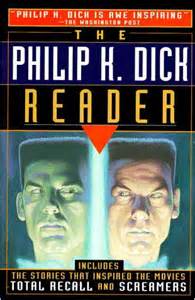
I received as a present a few years back a great book called the Philip K Dick Reader, it has all the short stories in one place. I know I have mentioned this in other posts, but I am a big fan of omnibus volumes. I had seen the movies, I think Minority Report had come out sometime before I got the book and I expressed a desire to read the story. It always interests me in where adaptations decide to diverge and what they leave out, and add in. I have read Washington Irving’s The Legend of Sleepy Hollow, and complained throughout the Depp movie that was based on it because it just shared the name pretty much but not much else, so it is a double edged sword, knowing the actual stories, sometimes it ruins the suspension of disbelief that is required to make it real.
But, with Dick, even when it diverges, it is like the essence, the reason behind the story creeps in. Hollywood cannot get rid of the message, it is in too deep. Total Recall is a good example. It has a lot of 80’s action movie and heavy cussing in it, it is a Verhoeven film more than a Dick story, by far. But the thing is, the actual story is so short and I can honestly say they needed to add more to the plot to make it work. It couldn’t be faithfully adapted into a two hour movie, and that is largely the case with Dick’s work.
In the end, the story has an ambiguous ending, you can’t definitively say whether he actually was a secret agent that went to Mars, or whether he was a vegetable at the vacation place, you can interpret it either way, and the movie stayed true to that. Both interpretations work which makes you question what is real, which is the question behind the story, and the movie itself, despite all the explosions and distractions that were added to make it flashy.
Minority Report I felt was mostly true to the story, I expected it to be further removed honestly because that is the trend with Dick’s work, and in general. The movie Adaptation deals with this quite well, actually. Basically it is a writer’s job and purpose to create, to recreate another person’s dream and be totally faithful to it is hard, because in the end we all want to create something new. It is a struggle because is any idea new, then becomes a question in of itself.
I also binge watched season two of The Man In the High Castle. This is an amazon show, so if you have prime it is easy to watch because you have all ready paid for it in a sense by being a member. You don’t have to buy it again, or pay for it and it is all out there to watch, no waiting each week for an episode to air. I didn’t quite enjoy season 1, so I wasn’t eagerly awaiting season 2. In fact, I only watched it because it came out around Mr Dick’s birthday, so I felt like maybe I should at least see it. And, you know what, season 2 was actually very very good.
It even had some Dick-ish themes going along in the background. What is reality? What is the truth? What is good what is evil? Can doing a horrible deed end up being the right thing to do? I haven’t read The Man in the High Castle, unfortunately, I have heard that the series diverges a great deal, and that isn’t surprising. But, I can say, that I felt the message behind it, the feeling, the questions in the background, are true to his work. So, the writers kept that in. I am starting to wonder if it is possible to remove this quality from his stories, as even the most crazy adaptation has it insidiously there, somewhere in the background, you just can’t remove it.
Back to Blade Runner, because it also isn’t a particular faithful adaptation. I have read Do Androids Dream of Electronic Sheep?, it is a great story. Much like We Can Remember it For You Wholesale, it is short, and I can see the need to add much to the plot to make it a full length film. Dick loved Blade Runner, and saw it as an improvement on his story. The fact that it didn’t replicate his story didn’t seem to bother him, he in fact was honored that the creative team managed to spin this story out of his own. Ultimately, the question behind both stories remain, what does it mean to be human? What does it mean to be alive? West World the TV show deals with the same questions as well as the movie AI, which was based on a Brian Aldiss story, which I have also read.
Yes, the movie again departs heavily from the source, but it is also a series of short vignettes. So, of course it would diverge by necessity.Aldiss was annoyed by the merging of his story with the story of Pinocchio, but again, Pinocchio deals with what it means to be human, to be real, what makes him a puppet and how he eventually becomes a real boy. When there are no more real boys, will the close approximation of one be a real one as it is the most real one in existence?
The same questions are asked and the story of the other, and how we treat who we regard as the other is dealt with similarly. Whoever is considered less than is seen as a threat, and ultimately considered disposable. The African slaves are an example of this in real life, the American Indians, the Australian aborigines, anytime someone is considered the ‘Less Than’ by others they are treated horribly and sometimes eradicated as a perceived threat. We are threatened by things we cannot understand, and robots, computers, androids are good representations of this fear, of this irrational destructiveness we have toward the unknown or the misunderstood of the perceived ‘Less Than.’
We can use science fiction to look at these problems in a way that gets around any programming we may have received in our lives. You can have false beliefs toward a whole group of people than watch someone mistreat a robot on a TV show or in a book, and just maybe it can open your mind, and cause you to question the very belief that you think of as reality even though what you witnessed on TV or in a book is outlandish and far from real.
By taking it out of reality, it allows us as people to question reality. By being supremely unreal and untrue, we can learn real truth.I feel that Dick knew that, and played on that in his works. A Scanner Darkly deals directly with what is real, perceived reality versus a definitive reality. I think what is real is one of fiction’s greatest questions and it can be asked in so many interesting ways.

 The Infamous Jennisfora Strikes Again...or something like that