Posted in Fiction, Uncategorized, Writing

Writing Prompt–Virtual Currency

*This is inspired from James Mascia’s Other Worlds Writing prompts.


Tap, tap,tap went the keys on the keyboard as a ring of screen monitors surrounded him with multiple windows up and running on each one. All the major banks and credit bureaus were accounted for, now for the final crash to the system. Bitcoin was inspirational for sure, he thought to himself, but they didn’t quite go far enough. In order for a virtual currency to become the dominant currency, the faith in paper money had to be shown for the stack of card houses it truly was.

You have to knock that first domino over to cause the rest to fall. After many hours of research and hard labor from not only him, but a myriad of sources and fellow hackers and economically disenfranchised people with an especially sharp axe to grind, the moment was at hand. Revolution never tasted so sweet.

The government of course, was one step behind, but he knew even a tiny delay could cause everything to fall apart. Everything was in place, the currency was thriving in pirate bays and other underground places in the dark side of the internet. This last punch of a string of fatal code should be the push to cause the rest of the unknowing sheep to follow suit as they will not know where else to go, and hopefully, his contacts in the media will follow through and educate them on the true path.

He sipped noisily on his Dr. Pepper, pushing the stale uneaten remains of the Doritos onto the floor. He would clean it up later, for now, click, the last key stroke. He smiled as the light of the screen reflected off his glasses, gleaming a bluish color as several streams of words and numbers lit up all the screens and other hackers across the world typed along with him at the same moment, each doing their part in a bigger puzzle. Viva La Revolution. Time for a new world order, controlled by the hackers, gamers, slackers, and under represented geniuses of the internet.

He smiled smugly, nodding to himself as if at some unspoken joke. So, this is what power feels like. He leaned back in his chair, watching the chaos, a TV was in the far corner, he took the remote turning it on waiting for the news. The weather man droned on and on about the chance of showers motioning and aiming his hands on a virtual background behind him. Jerry sighed impatiently. Come on, how long until his friends come through? Of course, he knew it wouldn’t be instantaneous.

News can be, and often was, but when it came to messages that could be controlled, and directed for mass effect, sometimes timing was everything. And, he expected the establishment boogeymen to attempt to spin and control this. The last gasping struggle of a dying behemoth who would crush many when it fell. Reasonable casualties to be expected, he thought coldly to himself. Every revolution had them, and losses were to be expected. Change was painful, and the greater the change the more painful it could be.

Suddenly, there was a  loud ringing knock at the door, he jumped up from his chair turning toward the door, not saying a word. “Hey, Jerry, is that you in there? Are you hungry? I can order a pizza?”

Jerry got up reluctantly hitting the monitor button on his computer not wanting his mother to see what he was working on. “Just a minute. I’ll be right there.” He walked over to the door unlocked the  dead bolt, opened the door slightly. The door banged open hitting him in the face hard, he fell down to the floor knocking the breath out of him. “Freeze. Police.”

“I’m sorry,” his mom said, with tears in her eyes. “They said if you cooperated, you might get immunity. They said you might be a terrorist, and that all these deaths would be on my head. I got scared. I’m so sorry, Jerry.”

He just looked up at her; blue eyes hating her with every fiber of his being. “You have no idea what you’ve done. None of you has any idea.” He watched her wring her hands nervously as they handcuffed him, shoving him up forcefully, his face bruised and swelling from hitting the floor a moment before.


Posted in Fiction, Uncategorized, Writing

J.R.R. Tolkien–Birthday Post part 2

Now on to Tolkien. Honestly, I am getting burned out talking about Tolkien but he still dominates Fantasy, so he will inevitably pop up in any conversation about it. Fantasy is just starting to diverge from the basic Tolkien-esque plot of country bumpkin becomes unlikely savior against the ultimate evil guy whose name cannot be said out loud.

Sounds familiar, doesn’t it? Truth is, Tolkien loved the English countryside and there is a distinctly environmentalist spin in The Lord of the Rings. Since, I hadn’t dealt with this aspect of Tolkien yet, this might be the post to do so.

The talking trees, the tranquility and peacefulness of the shire. The lack of technology and the idealization of country life all point to his love of the past and of pre-World War Britain. I mentioned in a previous post Tolkien’s love of Beowulf and Saxon England, his love of pre-industrial England was obvious. And, one has to like how he has nature fight back, literally, the trees rise up and fight. In some ways, he was way ahead of his time.

Sometimes, looking back is a way of looking forward. Language and linguistics were his passion, and what he was a professor of, although I read that he could be hard to understand and mumbled when he spoke.

I have read that he didn’t intend to write a novel, but started out trying to invent a language, and the novel was the back story for the language which grew in the telling and eventually became a series of novels.

I was introduced to The Hobbit a long time ago by the Rankin Bass cartoon, with its folk-ish singing and cartoony looking hobbits. I think it actually made me cry when the dwarf king died. I guess part of me wished that he had another chance to redeem himself. Tolkien believed in an afterlife, even in Middle Earth, so it is possible that he found redemption there, but as a kid death seems so permanent.

The Hobbit was aimed at children, and is easy to read but the story is still interesting to read as an adult. Lord of the Rings is harder to read in that it is more descriptive and appears to be aimed squarely at adults. Before Lord of the Rings, most fantasy was what was termed Fairy Stories and were intended for children only. Fantasy was not aimed at adults for the most part. There were some unclassifiable stories like Gormenghast, called a Gothic Novel, because Fantasy was not an active label yet.

George McDonald was another early fantasist. Not sure if he was marketed toward children only, but an adult can get enjoyment out of it. C.S. Lewis’ Narnia Chronicles were also aimed at children primarily, of course.

This is what made Lord of the Rings so special, it was fantasy for adults, it made it okay for adults to read this. And, if we look back to the original Grimm’s Faerie Tales, children’s tales could be quite violent and gory. The fate of Cinderella’s step sisters and mom for instance, toes chopped off to fit into shoes and the step mom dragged behind a carriage until dead. Harsh. We think what children are exposed to today is harsh, but historically, children have always been exposed to some darkness even in the stories supposedly tailored for them.

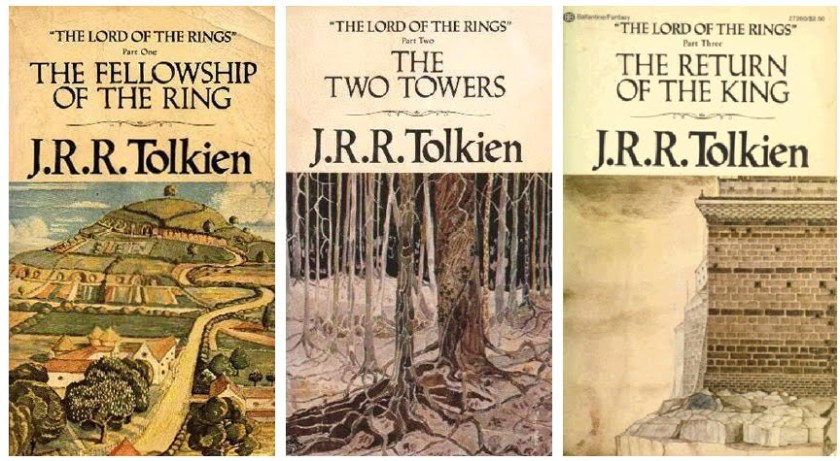
The Lord of the Rings was originally one big novel, it was broken into three because the publisher thought it would be easier to market and less of a risk to do it this way. Tolkien did not write it as a trilogy. Also, it was subjected to illegal publishing in America via Ace. Somehow, the rights were not secured over here in the U.S., so an unauthorized version was being printed.

The Ace edition was in print for years, so that Tolkien actually put a disclaimer in the official copies asking his readers to only purchase the official copies since of course, he got no remuneration from the illegal copies. Eventually, Ace had to stop printing it as the rights got sorted out, but one wonders if having it out and about helped create the later popularity of it, as at first it was more of a cult following for college kids and was far from main stream reading.

‘Frodo Lives’ was sighted here and there showing that it was growing by word of mouth.The future writers of Dungeons and Dragons would be heavily influenced by Tolkien and create a whole sub-culture of table top gaming and fantasy culture.

This is going to seem unrelated, but the blip in the rights type of situation made me think of it. And this offers an example where the gap in rights actually made a significant difference. The Christmas classic It’s a Wonderful Life also had a time without secured rights. This actually saved the film from obscurity and actually was what contributed to it being a classic.  Because Columbia forgot or neglected to nail the TV rights down, any channel could show it whenever they wanted without paying any royalties or fees.

This made it free game, and an easy way to fill a TV slot during the holidays. So, naturally, it became something that was put on TV on many channels every holiday, until it became tradition. So, eventually, Columbia wised up, and said, ‘We should be getting paid for this’ or something along those lines, and secured the rights, but now these channels had been airing it every year, and it was expected that they would continue to do so, but now Columbia got paid, and It’s a Wonderful Life became a classic even though in its day it was a flop and not regarded as anything special.

The Ace fiasco might have helped the popularity in the end because it allowed more people to access it because the Ace copies were cheaper, of course. Interesting idea but I suppose we cannot know if it helped or not, but obviously, a writer like any artist, deserves to get paid for their work, and I am not suggesting otherwise. It was a gaffe on the UK publisher’s part. Possibly they didn’t see the US as much of a market for this book, if that was the reasoning, they were very much mistaken.

In summary, we are still dealing with the legacy of Tolkien and Asimov, and I think both will be pillars in their genres for many years to come.


Posted in Fiction, Uncategorized, Writing

Isaac Asimov– A Birthday Post Part 1

Part 2 will deal with Tolkien and Fantasy. It is a bit humorous that Asimov read and enjoyed The Lord of the Rings, and Tolkien had read Asimov’s science fiction and liked it, apparently. They were both giants in their genre, and highly influential and still define their genres to many to this day.

Beyond this, they were very different. Asimov was a New Yorker, and an atheist. Tolkien an English gentleman and a devout catholic. Asimov wrote a lot of what we call Hard Science Fiction, which is a hard branch of sci-fi to successfully write.

For one thing, your readers, probably largely thanks to writers like Asimov, expect you to have knowledge of scientific processes. You have to do your homework and your research. There isn’t any excuses, or wand waving, or light saber battles here. Hard sci-fi can be very dry and cerebral to those that don’t read it often. It isn’t always done well. Asimov’s writing style was known to be dialogue heavy and bare of a lot of description, but he could always explain his science in layman’s terms.

He knew and worked with a lot of the greats in science-fiction. His editor was John Campbell, who has an award named after him, and he knew everyone. Heinlein, Ellison, Arhur C Clarke, Frederick Pohl.

I have a few books of his, the Foundation Trilogy, which might be more than three books, so perhaps trilogy is the wrong term, and Magic- The Final Fantasy Collection, which is a collection of his fantasy short stories he wrote. Asimov was quite prolific and wrote and published thousands of stories. He was the epitome of hard sci-fi for a long time. I enjoy Heinlein as well, because he deals with situations that kind of make you think. His characters were more developed in a way, but Asimov’s science was stronger.

Hard Sci-fi typically doesn’t make it into the mainstream media, the much softer “Space Opera” like Battlestar Galactica or Star Wars tends to dominate because the science is downplayed or not there at all, and more is focused on the characters. The only one I can think of that is actually called hard sci-fi is The Expanse based on a S.A. Corey series. I am excited for this show because of this, it is a thinking person’s science fiction.

I would argue West World could fit here as well, and possibly Orphan Black, because the science is at least mentioned which is more than some shows. I would say Orphan Black has the best of both worlds with unique  characters and a science background, but it is to be seen if the writers can continue to do the dance between the science and the plot. Asimov’s writing is still influencing Science-Fiction, and I actually enjoy reading heavy dialogue, it is kind of how I write as well so it gives me hope to know that a writer can be successful with that type of writing style.

His “Law of Robotics” also has affected a lot of the culture’s view on robots and machines and on their ability or inability to hurt people. Like in the Dick article I wrote, A.I, Blade Runner, many of these deal with robots who aren’t supposed to be able to hurt people going rogue. Asimov cemented the idea of making a robot incapable of harming a human. He is credited with coining the term robotics itself, and also wrote many science articles that were non-fiction to educate people on science.

Ultimately, a very interesting individual and writer that I would love to read more of. Feel free to add any comments on specific works and if he was an influence on your writing or anything I may have missed. This is the brief version, he was very prolific, this is just a basic overview of his life and work. I am aware I haven’t even scratched the surface.

Posted in Life, Uncategorized, Writing

Happy New Year! And a Quick Overview of My Goals and My Fight with Social Anxiety

Another year will die tonight and the new year will be born. I love New Year’s because I love the ability to start over and renew myself and who I am. I always feel like it is a good time to embrace change and forgive myself for my failings. It is a good time; a new time. And, I usually embrace it.

I feel pretty happy with life in general right now. Sometimes I feel perhaps a bit too isolated due to my constant fight with social anxiety and the ability to enjoy life and working way too  much. It is funny but I love one on one interactions, it is the larger groups of people that make me nervous. I know that the crowd won’t hurt me, but the anxiety can be so intense that I have the desire to flee running from the building, and I have. I have actually ran out of more than one building. If I stay, I must really really care. A lot. Because it is sheer terror, so, if I stay for you, yeah, it is something monumental. It means a lot, I don’t do that for many people.

I have been forcing myself to be braver and take more risks and force myself to sit in crowds in church, and other places. It is a struggle, like always, but dealing with irrational phobias usually is because they are irrational by nature.

Sometimes writing in a coffee shop can be energizing because of the conversations swirling around me but then I am separate from the crowd. I am safely ensconced by my computer while they engage in human interaction as I silently observe and take mental notes for future dialogue possibilities or character traits.

Somehow I can stay, maybe the laptop is  magical. Or maybe it is my shield from the world encroaching on me, suffocating me. I am going to attempt to attend a New Year’s party, wish me luck, and partly I am doing this to attempt to end the phobia by exposure to the cause of the fear. Maybe it has helped, but the anxious feeling seems to always be there, it never goes away completely. Maybe it never will.

My motto for this year and my goals are simple. Write more, at least something daily, stay in shape, and strive to be a better human by conquering my fears and experiencing success. I also hope to find love, preferably amazing true love, but you know, maybe I am asking for a bit too much for one year. To all that pass this way, good fortune, and may your dreams come true and much success for you and your loved ones!

*hugs* from JennRae

‘It is change, continuing change, inevitable change, that is the dominant factor in society today. No sensible decision can be made any longer without taking into account not only the world as it is, but the world as it will be.’
— Isaac Asimov
Posted in Fiction, Uncategorized, Writing

Part 2– Dealing with Fantasy and Moorcock

Okay, so part 1 dealt mostly with Science Fiction, robots, reality and Philip K Dick. This part deals with Fantasy, and Moorcock.

This one will be shorter, as I have bought books by Moorcock, but never got around to reading them. In my research of the man though, I am thinking about starting to read them now. He had a lot of good quotes about writing, and the nature of fantasy, and his current view of where it is at. And, I found myself agreeing with him on several points.

One, he sees current fantasy writing as largely stale and derivative of Tolkien. Note, he probably was quoted as feeling this way in the 90s. Whether he thinks this of the current crop of books, I have no idea. But, when his books were the end all be all, the heydays of Terry Brooks, Jordan, Kurtz, and many many others, this was definitely the case. They were all mostly different writing levels of Tolkien some lighter, some darker, some deeper, some more silly, here’s looking at you, Piers Anthony.

Then, George RR Martin came along, as well as some others of a similar bent. Sci-fi authors trying their hand at epic fantasy. Cj Cherryh also wrote a good series about this time which took some ancient lore and spun it in an interesting way. Raymond E Feist I would put here too,  because he managed to incorporate a Japanese type culture into fantasy in a seamless way that was definitely refreshing and different.

The people who had been writing it all along must have felt annoyed at these very experienced writers coming along into their genre and knocking all the tropes and pieces onto the floor, disregarding all the old formulas that had been working since the sixties. You re-wrote Tolkien, or you re-wrote King Arthur, but pretty much stick to the basic hero’s journey, Star Wars but with magic and not in space. Now, you got not just heroes and villains but everything in between. Beloved characters die in horrible ways, the apprentice doesn’t always succeed the teacher, the farm boy isn’t necessarily the chosen one. The good guys don’t always win.

The board and pieces were so changed that the game could not be called checkers anymore, but was more like chess. Fantasy was exciting again. Moorcock was ahead of his time, his novels were written before all this, he was writing Arthurian type fantasy, but with a gritty edge and some politics thrown in. Sure, there were elves, but these elves weren’t supernatural perfect beings but had conundrums and issues and politics. They weren’t the all wise angelic elves of Tolkien.

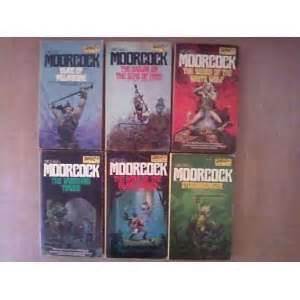
Although, Tolkien didn’t always portray all elves this way. The forest elves seem more human than the others in that they seem to have jealousy, and pettiness as traits. Still, I give him credit. I bought his books because, I loved the cover art. Guy Gavriel Kay might have the same artist, it is a similar style to his cover art, very stylized, and I liked it. So, I did the cardinal sin of judging a book by its cover and I would buy them on sight at the thrift stores.

I had several of his Elric of Melnibone books, but never got around to reading them. The cover art was stunning. I am not sure if I still have them, they may have been lost in one of the book purges that happened in my life. If not, I may try to find an omnibus volume and devour it. Because I think I would have enjoyed them immensely. Sometimes when you buy more than you can read, true gems fall by the wayside, and I am afraid that is what happened here.

I found a blog post about the cover art, which was by Michael Whelan, I should have known, as he did a lot of the DAW covers back in the day. A great artist. The link is below: http://fantasticflipout.blogspot.com/2009/11/michael-whelan-does-elric-of-melnibone.html


Posted in Fiction, Life, Writing

Merry Christmas, Happy belated birthday to Philip K Dick and Michael Moorcock, and of course, Humphrey Bogart and any others I may have forgotten —Part 1

Okay, with the title out of the way, this is my belated post that I mentioned I would write. The one where I go on and on about Dick, and mention Moorcock, but mostly talk about Mr. Dick.  I assure you this post is about writing, and ideas, and fantasy and science fiction.

The reason for the Bogart mention, is besides the fact I am a huge fan of his movies, he was also a huge fan of writers and writing. So, I think a happy birthday is definitely in order, besides the old detective genre of movies has definitely affected how Hollywood portrays some of Philip K Dick’s stories. Blade Runner and Total Recall both have a taste of them, Blade Runner especially, has almost a feel of a Maltese Falcon type of feel with the detective/policeman voice over. My brain which is full of associations paused and just thought, ‘Harrison Ford, Blade Runner, Millennium Falcon, Star Wars, Maltese Falcon, Bogart.’ It can be truly wondrous how the brain works as I have recently seen Rogue One, and binged West World, my mind is just full of interesting connections right now.

In fact, Rogue One resurrected Peter Cushing much like an episode of TV did Bogart, to reprise a role. West World owes much in ideas and even its existence to Blade Runner, more than the original West World, which heavily influenced The Terminator which starred Schwarzenegger who starred in Total Recall, which was based on We Can Remember it For You Wholesale by Dick.

My brain is spinning from the universal connections some of these ideas have. To write something that permeates society so deeply and shows up so unexpectedly in so many different ways is I think many writer’s dream. I would say all writers but that begs an arrogance that I don’t possess.

I can’t know what all writer’s want, but I know what I would like. I don’t need fame, money is nice, but being rich has never been a goal of mine except as a child perhaps, but what I do crave is having a sense of permanence. Leaving something behind when I am gone, a deep carving in the rock saying ‘I was here. I lived, and I mattered, and this is what I stood for, this is what was important to me, this is my contribution to society. to my family, to myself, to the world.’

I think from what I have read of Philip K Dick, that he felt similarly. I can’t say the same because I will never know, but from the quotes I found, from the stories I read, he had a deep philosophical bent, which I also like to think I have in my writing, and meaning and legacy seem to have been a big deal. He had an existential streak that I also have, where the meaning of being alive, what it means to be human, what it means to exist was in the background of many of his stories sharing a strong strand of what does it mean to be real, what is reality, another question that I love to deal with. He was so effective at these two questions that I have found them, along with what is true, or the truth,  are the back bone of every story he wrote.

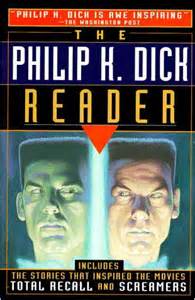
I received as a present a few years back a great book called the Philip K Dick Reader, it has all the short stories in one place. I know I have mentioned this in other posts, but I am a big fan of omnibus volumes.  I had seen the movies, I think Minority Report had come out sometime before I got the book and I expressed a desire to read the story. It always interests me in where adaptations decide to diverge and what they leave out, and add in. I have read Washington Irving’s The Legend of Sleepy Hollow, and complained throughout the Depp movie  that was based on it because it just shared the name pretty much but not much else, so it is a double edged sword, knowing the actual stories, sometimes it ruins the suspension of disbelief that is required to make it real.

But, with Dick, even when it diverges, it is like the essence, the reason behind the story creeps in. Hollywood cannot get rid of the message, it is in too deep. Total Recall is a good example. It has a lot of 80’s action movie and heavy cussing in it, it is a Verhoeven film more than a Dick story, by far. But the thing is, the actual story is so short and I can honestly say they needed to add more to the plot to make it work. It couldn’t be faithfully adapted into a two hour movie, and that is largely the case with Dick’s work.

In the end, the story has an ambiguous ending, you can’t definitively say whether he actually was a secret agent that went to Mars, or whether he was a vegetable at the vacation place, you can interpret it either way, and the movie stayed true to that. Both interpretations work which makes you question what is real, which is the question behind the story, and the movie itself, despite all the explosions and distractions that were added to make it flashy.

Minority Report I felt was mostly true to the story, I expected it to be further removed honestly because that is the trend with Dick’s work, and in general. The movie Adaptation deals with this quite well, actually. Basically it is a writer’s job and purpose to create, to recreate another person’s dream and be totally faithful to it is hard, because in the end we all want to create something new. It is a struggle because is any idea new, then becomes a question in of itself.

I also binge watched season two of The Man In the High Castle. This is an amazon show, so if you have prime it is easy to watch because you have all ready paid for it in a sense by being a member. You don’t have to buy it again, or pay for it and it is all out there to watch, no waiting each week for an episode to air. I didn’t quite enjoy season 1, so I wasn’t eagerly awaiting season 2. In fact, I only watched it because it came out around Mr Dick’s birthday, so I felt like maybe I should at least see it. And, you know what, season 2 was actually very very good.

It even had some Dick-ish themes going along in the background. What is reality? What is the truth? What is good what is evil? Can doing a horrible deed end up being the right thing to do? I haven’t read The Man in the High Castle, unfortunately, I have heard that the series diverges a great deal, and that isn’t surprising. But, I can say, that I felt the message behind it, the feeling, the questions in the background, are true to his work. So, the writers kept that in. I am starting to wonder if it is possible to remove this quality from his stories, as even the most crazy adaptation has it insidiously there, somewhere in the background, you just can’t remove it.

Back to Blade Runner, because it also isn’t a particular faithful adaptation. I have read Do Androids Dream of Electronic Sheep?, it is a great story. Much like We Can Remember it For You Wholesale, it is short, and I can see the need to add much to the plot to make it a full length film. Dick loved Blade Runner, and saw it as an improvement on his story. The fact that it didn’t replicate his story didn’t seem to bother him, he in fact was honored that the creative team managed to spin this story out of his own. Ultimately, the question behind both stories remain, what does it mean to  be human? What does it mean to be alive? West World the TV show deals with the same questions as well as the movie AI, which was based on a Brian Aldiss story, which I have also read.

Yes, the movie again departs heavily from the source, but it is also a series of short vignettes. So, of course it would diverge by necessity.Aldiss was annoyed by the merging of his story with the story of Pinocchio, but again, Pinocchio deals with what it means to be human, to be real, what makes him a puppet and how he eventually becomes a real boy. When there are no more real boys, will the close approximation of one be a real one as it is the most real one in existence?

The same questions are asked and the story of the other, and how we treat who we regard as the other is dealt with similarly. Whoever is considered less than is seen as a threat, and ultimately considered disposable. The African slaves are an example of this in real life, the American Indians, the Australian aborigines, anytime someone is considered the ‘Less Than’ by others they are treated horribly and sometimes eradicated as a perceived threat. We are threatened by things we cannot understand, and robots, computers, androids are good representations of this fear, of this irrational destructiveness we have toward the unknown or the misunderstood of the perceived ‘Less Than.’

We can use science fiction to look at these problems in a way that gets around any programming we may have received in our lives. You can have false beliefs toward a whole group of people than watch someone mistreat a robot on a TV show or in a book, and just maybe it can open your mind, and cause you to question the very belief that you think of as reality even though what you witnessed on TV or in a book is outlandish and far from real.

By taking it out of reality, it allows us as people to question reality. By being supremely unreal and untrue, we can learn real truth.I feel that Dick knew that, and played on that in his works. A Scanner Darkly deals directly with what is real, perceived reality versus a definitive reality. I think what is real is one of fiction’s greatest questions and it can be asked in so many interesting ways.

“That was my problem then and it’s my problem now; I have a bad attitude. In a nutshell, I fear authority but at the same time I resent it — the authority and my own fear — so I rebel. And writing SF is a way to rebel. … SF is a rebellious art form and it needs writers and readers and bad attitudes — an attitude of “Why?” or “How come?” or “Who says?”

Philip K Dick, From the forward to The Golden Man