
Posted in Uncategorized

What is a Word That Too Many People Use?

There are a few words I can think of off the top of my head. The Word “like” being the obvious one. I hear a lot of people use it as a filler word the way some use the noise “umm” to fill in the space while they look for the word they actually want to use.

I have a lot of issues with “like” as a filler word. The obvious one is it annoys the crap out of me because the word no longer has any meaning, and if you actually are trying to use “like” to mean “like” it can get confusing because of how overused it is. The whole point of communication is to communicate, after all.

My other issue is that it makes the person automatically sound silly and like they are using “valley girl” speech, which is difficult to take seriously.

Some people think southern U.S. accents make people seem unintelligent. I personally don’t think so, I think they take their time, but that doesn’t signify unintelligence to me. Valley girl speech however, does sound unintelligent.

It sounds like you didn’t focus in school, don’t know many words, and that you may be a bit on the younger side. Although I have heard a 40 year old talk like this so this is a stereotype for sure.

So in addition to the overused “like” I have also noticed an uptick in the increasing use of the word “right.” Right is less obnoxious and less likely to cause me to judge you, but I have noticed it trending as a not quite filler word, so much as an “I agree with you so much” term.

For example I was training someone, a perfectly capable, intelligent, very nice person. So, I am not judging them for this, it is just the first example I can recall of this, but I am seeing it more and more in conversations.

Every time I would suggest or say anything, this person would say, “I know, right?” At first it was like, okay, it is a phrase. That’s fine. But it kept happening. Over three days, I would hear, “I know, Right.” Or sometimes, just ‘Right?” Implying, I know, right? And, now I can’t unhear it. Especially at work, I heard it the other day, and it sticks out to me.

It isn’t as overused as “like.” But, it is trending up. I feel like for me it sticks out especially. It is a phrase designed to inspire camaraderie, or agreement. It isn’t bad per se. Just being the way I am, I like to vary my speech a bit. I don’t want to get stuck using the same phrase over and over.

My mind tends to get suspicious of people being nice or kind, and I tend to then think why is this person telegraphing so hard that they are on my side? Why are they agreeing so much? Are they just that agreeable or are they not really listening?

It does seem kind of an autopilot type of phrase, something one might add when they don’t have an opinion or don’t know what to say. It is ultimately harmless. And I feel weird complaining about a phrase that inspires people to agree with one another, and not argue. It seems wholesome.

I guess I am suspicious of those that agree without asking follow up questions. I also am reluctant to fall into a catchphrase type of trap because I like diversity in my words. It seems like it would be easy to fall into this one because it is so agreeable and harmless.
Posted in Fiction, Uncategorized, Writing

J.R.R. Tolkien–Birthday Post part 2

Now on to Tolkien. Honestly, I am getting burned out talking about Tolkien but he still dominates Fantasy, so he will inevitably pop up in any conversation about it. Fantasy is just starting to diverge from the basic Tolkien-esque plot of country bumpkin becomes unlikely savior against the ultimate evil guy whose name cannot be said out loud.

Sounds familiar, doesn’t it? Truth is, Tolkien loved the English countryside and there is a distinctly environmentalist spin in The Lord of the Rings. Since, I hadn’t dealt with this aspect of Tolkien yet, this might be the post to do so.

The talking trees, the tranquility and peacefulness of the shire. The lack of technology and the idealization of country life all point to his love of the past and of pre-World War Britain. I mentioned in a previous post Tolkien’s love of Beowulf and Saxon England, his love of pre-industrial England was obvious. And, one has to like how he has nature fight back, literally, the trees rise up and fight. In some ways, he was way ahead of his time.

Sometimes, looking back is a way of looking forward. Language and linguistics were his passion, and what he was a professor of, although I read that he could be hard to understand and mumbled when he spoke.

I have read that he didn’t intend to write a novel, but started out trying to invent a language, and the novel was the back story for the language which grew in the telling and eventually became a series of novels.

I was introduced to The Hobbit a long time ago by the Rankin Bass cartoon, with its folk-ish singing and cartoony looking hobbits. I think it actually made me cry when the dwarf king died. I guess part of me wished that he had another chance to redeem himself. Tolkien believed in an afterlife, even in Middle Earth, so it is possible that he found redemption there, but as a kid death seems so permanent.

The Hobbit was aimed at children, and is easy to read but the story is still interesting to read as an adult. Lord of the Rings is harder to read in that it is more descriptive and appears to be aimed squarely at adults. Before Lord of the Rings, most fantasy was what was termed Fairy Stories and were intended for children only. Fantasy was not aimed at adults for the most part. There were some unclassifiable stories like Gormenghast, called a Gothic Novel, because Fantasy was not an active label yet.

George McDonald was another early fantasist. Not sure if he was marketed toward children only, but an adult can get enjoyment out of it. C.S. Lewis’ Narnia Chronicles were also aimed at children primarily, of course.

This is what made Lord of the Rings so special, it was fantasy for adults, it made it okay for adults to read this. And, if we look back to the original Grimm’s Faerie Tales, children’s tales could be quite violent and gory. The fate of Cinderella’s step sisters and mom for instance, toes chopped off to fit into shoes and the step mom dragged behind a carriage until dead. Harsh. We think what children are exposed to today is harsh, but historically, children have always been exposed to some darkness even in the stories supposedly tailored for them.

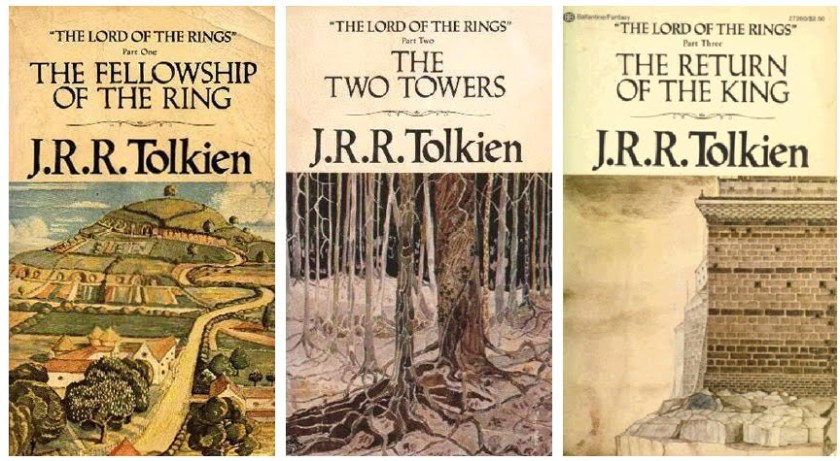
The Lord of the Rings was originally one big novel, it was broken into three because the publisher thought it would be easier to market and less of a risk to do it this way. Tolkien did not write it as a trilogy. Also, it was subjected to illegal publishing in America via Ace. Somehow, the rights were not secured over here in the U.S., so an unauthorized version was being printed.

The Ace edition was in print for years, so that Tolkien actually put a disclaimer in the official copies asking his readers to only purchase the official copies since of course, he got no remuneration from the illegal copies. Eventually, Ace had to stop printing it as the rights got sorted out, but one wonders if having it out and about helped create the later popularity of it, as at first it was more of a cult following for college kids and was far from main stream reading.

‘Frodo Lives’ was sighted here and there showing that it was growing by word of mouth.The future writers of Dungeons and Dragons would be heavily influenced by Tolkien and create a whole sub-culture of table top gaming and fantasy culture.

This is going to seem unrelated, but the blip in the rights type of situation made me think of it. And this offers an example where the gap in rights actually made a significant difference. The Christmas classic It’s a Wonderful Life also had a time without secured rights. This actually saved the film from obscurity and actually was what contributed to it being a classic.  Because Columbia forgot or neglected to nail the TV rights down, any channel could show it whenever they wanted without paying any royalties or fees.

This made it free game, and an easy way to fill a TV slot during the holidays. So, naturally, it became something that was put on TV on many channels every holiday, until it became tradition. So, eventually, Columbia wised up, and said, ‘We should be getting paid for this’ or something along those lines, and secured the rights, but now these channels had been airing it every year, and it was expected that they would continue to do so, but now Columbia got paid, and It’s a Wonderful Life became a classic even though in its day it was a flop and not regarded as anything special.

The Ace fiasco might have helped the popularity in the end because it allowed more people to access it because the Ace copies were cheaper, of course. Interesting idea but I suppose we cannot know if it helped or not, but obviously, a writer like any artist, deserves to get paid for their work, and I am not suggesting otherwise. It was a gaffe on the UK publisher’s part. Possibly they didn’t see the US as much of a market for this book, if that was the reasoning, they were very much mistaken.

In summary, we are still dealing with the legacy of Tolkien and Asimov, and I think both will be pillars in their genres for many years to come.